Product evidence
Pet Remedy Calming Diffuser for Dogs UK 2026: Honest Review
Pet Remedy reviewed honestly - how the valerian-based calming diffuser actually works, full UK product range (diffuser, spray, wipes, lick mats) with current prices, what the evidence shows (and where it does not), and when Adaptil is the better calming diffuser pick.

Quick Answer
Pet Remedy is a UK-developed herbal calming product founded in Devon in 2009, using a valerian-based essential oil blend that works across all species — dogs, cats, rabbits, rodents, birds and horses. Comes as a plug-in diffuser (~£94/year), spray (~£12 / 75 ml), calming wipes and Lick & Relax mats. It's the strongest budget and multi-pet household alternative to Adaptil, but be honest about evidence: the only peer-reviewed canine trial found no significant effect. Many owners still report subjective improvement, so think of Pet Remedy as a low-cost, low-risk first try rather than an evidence-led pick.
Honest evidence position
We don't claim Pet Remedy "works" with the same confidence we apply to Adaptil. The single peer-reviewed canine trial available didn't show statistically significant effects, and the brand's own testimonials are owner-reported rather than blinded. That doesn't make it useless — it means the evidence bar for honest recommendation is "some dogs respond, particularly in multi-pet homes where pheromone products won't help the cats", not "this is clinically proven".
What Pet Remedy is and how it works
Pet Remedy is a UK-developed product founded in Devon in 2009. Its primary active ingredient is valerian root oil (Valeriana officinalis), supported by vetiver, sweet basil and clary sage essential oils. Unlike Adaptil — which uses synthetic dog pheromones — Pet Remedy works through GABA enhancement: valerian contains valerenic acid, which inhibits the breakdown of GABA (a natural calming neurotransmitter present in all mammals).
Because GABA is mammal-wide rather than species-specific, Pet Remedy affects all species in the household — dogs, cats, rabbits, rodents, birds and even horses. That's a real advantage in multi-pet homes where Adaptil's dog-only pheromone wouldn't help an anxious cat or housebound rabbit.
Mechanism in plain English
GABA is the brain's "brake pedal" neurotransmitter — it dampens excitation. Valerian's valerenic acid stops the body breaking GABA down as quickly, so calming signals last longer. Whether this happens at meaningful doses via essential-oil inhalation in dogs is exactly what the missing peer-reviewed evidence would settle.
The Pet Remedy product range — UK 2026
| Format | What it is | Coverage / duration | UK price (approx) |
|---|---|---|---|
| Calming Diffuser starter kit | Plug-in diffuser + first refill | Coverage similar to Adaptil; refill lasts ~60 days | ~£24 |
| Diffuser refill | ~60-day refill bottle | ~60 days continuous use | ~£14 single, ~£10 each in 3-pack |
| Calming Spray (75 ml) | Spray on bedding, crate, car seatbelt or harness | 2-6 hours per application | ~£12 |
| Calming Wipes | Single-use wipes for paws/coat/bandanas | ~3-4 hours per wipe | ~£6 (20-pack), ~£18 (70-pack) |
| Lick & Relax Pot / Mat | Lickable surface infused with the calming blend | Single-use pot or reusable mat | ~£8 (pot) / ~£15 (mat) |
Annual diffuser cost vs Adaptil
This is Pet Remedy's strongest selling point. With ~60-day refills (vs Adaptil's 30-day) and a lower per-refill price, continuous diffuser use comes in at ~£94/year compared to ~£262/year for Adaptil — roughly one-third the cost. For multi-pet homes running diffusers in multiple rooms, the gap multiplies.
Does Pet Remedy actually work?
This is where we have to be honest. There is one published peer-reviewed canine trial on Pet Remedy, and it did not show a statistically significant effect. The brand also points to customer surveys reporting high satisfaction, but those are owner-reported, unblinded, and run by the manufacturer — directional evidence, not RCT-grade.
That said, "no significant effect in one small trial" is not the same as "doesn't work for any dog". Three honest framings:
- Individual variation matters. Many calming products produce real effects in some dogs and no effects in others. Aggregate trials average that out — a non-significant trial result hides the dogs who did improve.
- Placebo effect on owners is real. When you spray a calming product and your dog settles, you're more relaxed, which the dog reads. Some of the reported improvement is genuine improvement caused by the owner being calmer, mediated by the spray.
- Subjective ≠ useless. If your dog responds and you're happy with the result, the absence of an RCT doesn't make the outcome fake. It does mean we shouldn't recommend it the way we'd recommend a clinically proven option.
Practical position: Pet Remedy is a reasonable low-cost, low-risk first try, especially in multi-pet households where Adaptil won't help the other species. If you're after the evidence-led choice for a dog-only home, Adaptil has the stronger trial base.
When Pet Remedy works best
- Multi-pet households — dogs + cats + rabbits + rodents + birds. Adaptil only affects dogs; Pet Remedy works across species.
- Budget-conscious owners — at one-third the annual diffuser cost of Adaptil, sustaining a year of continuous use is much more affordable.
- Cats with anxiety — Pet Remedy is one of the few non-Feliway options for cats.
- Layering with Adaptil — different mechanisms (pheromone vs GABA), no documented interaction, can run both diffusers in the same home.
- Quick situational top-ups — the spray is fast and cheap. Spraying a bandana before a vet visit or a car ride is a low-friction try.
- Owners who prefer herbal/natural products — the active ingredients are botanical rather than synthetic.
When Pet Remedy might not be enough (or not the right pick)
- Dog-only households with severe anxiety — Adaptil's evidence base is stronger; Pet Remedy is less defensible as a primary intervention here.
- Acute panic during fireworks or storms — start a diffuser early but don't expect it to handle severe noise phobia alone. See the fireworks anxiety guide and UK anxiety medication guide.
- Established separation anxiety with destruction or self-injury — needs behaviour modification + likely prescription medication; herbal calming is too light an intervention.
- Aggression rooted in fear — refer to a clinical animal behaviourist; supplements alone are not the right tool.
- You want clinical evidence behind your purchase — pick an option with stronger trial data: Adaptil for pheromones, Zylkene tablets for alpha-casozepine, or L-theanine for amino-acid calming.
Pet Remedy alternatives worth knowing
- Adaptil — stronger evidence base (23+ peer-reviewed studies) but ~3× the annual cost and dog-only. Read the full Adaptil buying guide or the head-to-head Adaptil vs Pet Remedy comparison.
- Beaphar CaniComfort — uses the same DAP pheromone tech as Adaptil at a lower price (~£16 starter). Dog-only.
- Dorwest Scullcap & Valerian Tablets — UK-licensed herbal medicine in tablet form using valerian (same primary herb as Pet Remedy) plus skullcap, mistletoe and gentian. See the herbal calming remedies guide.
- Calming chews with valerian or tryptophan — ingestible alternative if your dog responds to oral calming. See the UK calming chews guide.
For a head-to-head ranking against Adaptil, ThunderEase, Beaphar and other UK pheromone/herbal products, see the best pheromone diffusers UK review.
UK pricing and where to buy
Pet Remedy is widely stocked in 2026:
- Pets at Home — full range, regular promotions on starter kits and 3-pack refills
- Amazon UK — usually competitive on individual refills and sprays
- VetUK / VioVet / Medic Animal — strong on multi-pack pricing
- Independent vet practices — increasingly stocked alongside Adaptil; price typically slightly higher
Cost reality check
For continuous diffuser use, expect ~£94/year (1 starter + ~5 refills). Spot use of the spray (~£12 per bottle) covers a year of car trips, vet visits and one-off events for under £15. Even running multiple diffusers in a multi-pet home, the total is usually still below a single Adaptil setup.
Safety and side effects
Pet Remedy has no known harmful side effects in healthy dogs at recommended use. The product is designed for ambient inhalation (diffuser) or surface application (spray, wipes), not ingestion — don't let dogs lick neat spray or chew the diffuser unit.
Three practical caveats:
- Pregnancy and very young puppies — Pet Remedy has historically advised caution with pregnant or nursing animals and very young puppies; check current label guidance and your vet if either applies.
- Birds and reptiles — essential-oil-based products can be more sensitising to birds and reptiles than to mammals. If you keep birds, parrots or reptiles, ventilate well and consider whether a pheromone product (Adaptil for dogs / Feliway for cats) is a safer fit.
- Drug interactions — none documented, but if your dog is on prescription anxiety medication (especially SSRIs or benzodiazepines), tell your vet before adding any herbal calming product. GABA-active herbs and GABA-active drugs theoretically interact, even if practical effects are small.
How to use Pet Remedy effectively
- Plug the diffuser in 24 hours before a stressful event so the room saturates. Same-day starts under-deliver.
- One diffuser per main room. Coverage is room-scale, not house-scale; multi-storey homes need one per floor where the pet spends time.
- Replace refills every ~60 days even if the bottle still has scent — like Adaptil, the active depletes faster than the carrier.
- For acute events (vet visit, car trip), spray a bandana or the inside of the carrier 15-30 minutes before. Don't spray directly onto the dog's coat near the face.
- Wipes for travel — quicker than spray, easier to dose, good for crating.
- Layer with behaviour work. Like every calming product, Pet Remedy is most effective alongside training, exercise and routine — not as a replacement.
- Trial 4 weeks before judging. The trial evidence is mixed at the population level; for any individual dog, a 4-week test is the cheapest way to find out whether it works for yours.
- If it's not working after 4 weeks, switch mechanism — try Adaptil's pheromone tech, or move to an ingestible like a tryptophan chew or Zylkene tablets.
Pet Remedy isn't the most-evidenced UK calming product, but for budget and multi-pet households it earns its place on the shelf. Try it deliberately, set a 4-week assessment window, and switch mechanisms if it doesn't help your specific dog.
UK picks from this guide
Products covered in this guide
Direct affiliate links to the UK products discussed above — prices refreshed from Amazon UK, no upcharge for using them.
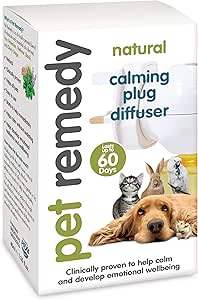
Pet Remedy
Pet Remedy Natural De-Stress Plug-In Diffuser
Multi-species calming diffuser using Valerian. Works on dogs, cats, and other mammals.
£16.78
Buy on Amazon UK
Pet Remedy
Pet Remedy Natural De-Stress Spray
Natural valerian-based calming spray. 200ml bottle for excellent value.
£14.33
Buy on Amazon UKBeaphar
Beaphar CaniComfort Calming Diffuser
Budget-friendly pheromone diffuser providing 30 days of calming support for anxious dogs.
£15.32
Buy on Amazon UK
ThunderShirt
ThunderShirt Anxiety Coat (Heather Grey)
The original patented anxiety vest using Deep Pressure Touch Stimulation. 80%+ proven success rate.
£36.40
Buy on Amazon UKCaptain Calm earns a small commission from qualifying Amazon UK purchases at no extra cost to you. Recommendations are based on independent research and review. Prices are pulled from Amazon UK and refreshed through the day; the price shown at checkout applies.
Keep reading
More on product evidence

Calming Treats for Dogs That Actually Work (UK 2026 Evidence)
Which calming treats actually work? L-theanine and alpha-casozepine have real canine evidence; valerian and chamomile mostly don't. Onset times, doses by weight, side effects — and the UK treats that contain enough active ingredient to matter (2026).

Adaptil vs Pet Remedy 2026: Side-by-Side UK Comparison
Adaptil vs Pet Remedy compared head-to-head — pheromones vs valerian herbs, evidence quality, £94 vs £262/year cost, and which suits which use case. UK 2026 update.

Best Calming Sprays & Drops for Dogs UK 2026: 5 Tested + Drops Comparison
UK calming sprays and drops compared — Adaptil, Pet Remedy, ThunderEase, Beaphar plus oral drops like Dorwest Valerian Compound. Onset times, price per ml, when to choose drops over sprays, and which suits travel vs home anxiety.