Supplements & natural remedies
L-Theanine for Dogs (2026): Dosage Chart, Safety & How It Calms
L-theanine for dogs: dosage chart by weight from the Anxitane label, side effects, safety, what the dog studies actually show, and UK supplements that contain it.

Quick Answer
L-theanine is an amino acid from tea leaves with more dog studies behind it than most calming supplements, though there are only three, all small. The dose used in those studies is the Anxitane label dose, given twice a day: 25mg for dogs under 10kg, 50mg for 10-24kg and 100mg for 25kg and over. Virbac advises starting about two weeks before a predictable stressful event. It calms without sedation, and no side effects were reported in the dog studies.
What is L-Theanine?
L-theanine (often written simply as theanine — it's the same compound; the "L" just denotes the natural form) is an amino acid naturally found in tea leaves (Camellia sinensis) and certain mushrooms. It has more dog studies than most calming supplements, but there are three, all small, and only one had a placebo group.
The amino acid was first identified in 1949 and has been extensively studied for its ability to promote relaxation without sedation—making it ideal for anxious dogs who still need to function normally.
How L-Theanine Works in Dogs
How it works in dogs hasn't been measured. What is known comes from other species:
- In rats: it enters the brain and raises serotonin and dopamine levels
- In people: it increases alpha-wave activity on EEG, associated with a calm, alert state
- Glutamate: it binds glutamate receptors only weakly, so claims that it "blocks" excitatory signals are overstated
In the only placebo-controlled dog study, it had no sedative effect. Your dog should stay alert and responsive, just calmer.
Our View
L-theanine is often described as producing "calm focus" rather than sedation. This makes it particularly valuable for training sessions with anxious dogs, as they can still learn and engage while feeling less stressed.
Scientific Evidence for L-Theanine in Dogs
There are three dog studies. All tested Virbac's Anxitane at its label dose:
Key Studies
Storm sensitivity (Pike et al. 2015): 18 storm-sensitive dogs were given Anxitane twice a day for at least 4 weeks. Owners reported less drooling (83%), panting (76%), pacing (79%) and hiding (79%), and 17 of 18 were satisfied with the treatment. There was no placebo group, so some improvement may be placebo effect in owners' ratings (Journal of Veterinary Behavior, 2015).
Noise phobia with training (Michelazzi et al.): 20 noise-phobic dogs all had 63 days of sound desensitisation and counterconditioning; 10 also had Anxitane. Both groups improved. Panting, drooling, lip licking, yawning and vocalising improved only in the L-theanine group. There was no placebo, and owners knew which group they were in.
Fear of strangers (Araujo et al. 2010): The only placebo-controlled study, in 10 laboratory beagles. It found less fear of strangers and no sedative effect.
Veterinary Clinical Use: Vets sell L-theanine products such as Anxitane for predictable stressful events like veterinary visits, grooming, or travel. (It is not part of the vet-prescribed "Chill Protocol", which uses gabapentin, melatonin and acepromazine.)
Evidence Quality Assessment
While the evidence is promising, it's worth noting:
- Studies are small (10 to 20 dogs)
- All three tested one product, Virbac's Anxitane, and only one had a placebo group
- Individual response varies significantly
- Larger independent studies would strengthen the evidence base
Despite these limitations, L-theanine has more dog-specific evidence than most calming supplements, where there is often none at all.
L-Theanine Dosage for Dogs UK
The doses below are the Anxitane label dose (Virbac UK), which is also the dose every published dog study used. Our L-theanine calculator gives the same bands, and the free dosing chart below has them in printable form.
Standard Dosing Guidelines
| Dog Weight | L-Theanine Dose (twice a day) | Anxitane tablets |
|---|---|---|
| Under 10kg | 25mg | Half an S (50mg) tablet |
| 10-24kg | 50mg | Half an M/L (100mg) tablet |
| 25kg and over | 100mg | One M/L (100mg) tablet |
General rule: For dogs over 10kg the label dose works out at about 2-5mg per kg per dose; small dogs get more per kg. No study has tested a per-kg dose in dogs, so follow the weight bands on the product.
When to Give L-Theanine
- Timing: Twice a day, morning and evening. For a predictable event, Virbac advises starting about two weeks before
- Onset: No study has measured how fast it acts in dogs. In people, blood levels peak about 50 minutes after a dose
- Duration: The dog studies gave it daily for 4 to 9 weeks
- With or without food: Either way
Daily Use vs Situational Use
Event-led use (starting ahead of a known stressor):
- Before vet visits
- Before car journeys
- During storms or fireworks
- Before grooming
- During house guests
Daily use (for chronic anxiety):
- Give twice daily at the label dose
- The dog studies saw improvement over 4 to 9 weeks
- No side effects were reported in studies of up to 9 weeks; there is no longer-term data in dogs
- Discuss with vet for ongoing anxiety issues
Is L-Theanine Safe for Dogs?
L-theanine has an excellent safety record in dogs:
L-Theanine Side Effects in Dogs
L-theanine is remarkably well-tolerated. Reported side effects are rare and typically mild:
- Gastrointestinal upset: Occasionally seen at very high doses
- No sedation: The placebo-controlled dog study found no sedative effect
Safety Considerations
- Toxicity: No side effects were reported in the dog studies, and a 13-week rat study found no adverse effects at up to 4,000mg per kg a day
- Long-term use: There is no dog data beyond 9 weeks
- Pregnancy/nursing: Insufficient data—avoid or consult vet
- Puppies: Generally considered safe but consult vet for dogs under 6 months
Drug Interactions
No interactions have been studied in dogs; these are based on rat and human data. Tell your vet if your dog takes:
- Blood pressure medications: L-theanine may enhance effects
- Other calming supplements or medications: Effects may be additive
- Stimulant medications: May reduce effectiveness of stimulants
Important Safety Note
While L-theanine is very safe, always consult your vet before starting any supplement, especially if your dog has underlying health conditions or takes other medications. For severe anxiety, L-theanine alone may be insufficient—professional assessment ensures appropriate treatment.
L-Theanine Products Available in the UK
When choosing an L-theanine product, check the actual L-theanine content per dose:
Dedicated L-Theanine Products
Anxitane (Virbac):
- A complementary feed from Virbac (not a licensed medicine), sold through vets
- S = 50mg, M/L = 100mg of L-theanine from green tea concentrate, with fillers and fish flavouring
- The product used in all three dog studies
Combination Products Containing L-Theanine
Many calming treats and supplements include L-theanine alongside other ingredients:
- Nutracalm (Nutravet): 100mg L-theanine per capsule with L-tryptophan, GABA and passionflower. Nutravet says it works within 1-2 hours
- KalmAid (Swedencare): The UK formula lists L-theanine (from green tea) with L-tryptophan, though some Amazon listings describe valerian and chamomile instead, so check the pack; the maker doesn't state amounts. Given 1-2 hours before an event
- ADAPTIL Chew: Green tea extract (a source of L-theanine, amount not stated) with L-tryptophan, given about 30 minutes before
- YuMOVE Calming Support (formerly YuCalm): Contains no L-theanine; its main active is 200mg L-tryptophan
- Zylkene: A different ingredient (alpha-casozepine from milk protein), started 1-2 days before an event
- Various calming treats: Check labels - many contain L-theanine but amounts vary widely. Look for products specifying at least 25mg per dose
For a full head-to-head of the UK's main calming supplements — Anxitane, Zylkene, YuMOVE, Nutracalm and Dorwest — including ingredient doses and monthly costs, see our best calming tablets and supplements review.
What to Look For
- Stated L-theanine content: Products should specify exact mg per dose
- Suntheanine brand: A patented, pure form of L-theanine with consistent quality
- Appropriate dose for your dog's size: Many treats contain insufficient amounts for larger dogs
- Reputable manufacturer: Choose established pet supplement companies
L-Theanine vs Other Calming Supplements
How does L-theanine compare to other popular options?
L-Theanine vs Zylkene (Alpha-Casozepine)
| Factor | L-Theanine | Zylkene |
|---|---|---|
| Source | Tea plants | Milk protein |
| When to start | About two weeks before (Anxitane label) | 1-2 days before (Zylkene label) |
| Dog evidence | Three small studies, one placebo-controlled | Small studies; a 2024 placebo-controlled trial found a weak effect |
| Can combine? | Not studied together; add one at a time, a week apart | |
Melatonin is a prescription-only medicine for dogs in the UK and its anxiety evidence is case reports; ask your vet before combining it with L-theanine.
L-Theanine vs CBD Oil
- Legal status: CBD products for pets cannot legally be sold in the UK and none is authorised for dogs; L-theanine products can be
- Evidence: L-theanine has more dog studies; a controlled study using a fireworks recording found CBD didn't reduce fear
L-Theanine vs Prescription Medications
L-theanine is not a replacement for veterinary-prescribed anxiety medications in cases of:
- Severe separation anxiety with destructive behaviour
- Self-harm during panic episodes
- Aggression related to anxiety
- Anxiety significantly impacting quality of life
For these cases, see our guide on prescription anxiety medications for dogs.
When L-Theanine Works Best
L-theanine is most effective for:
- Mild to moderate anxiety: Dogs who are nervous but not panicking
- Situational stressors: Vet visits, car travel, grooming, visitors
- Noise sensitivities: Storms, fireworks anxiety (especially combined with other strategies)
- Training support: Helping anxious dogs learn while calmer
- As part of combination approaches: Works well alongside behaviour modification
When to Consider Other Options
- Severe panic responses
- Self-injury during anxiety episodes
- Anxiety-driven aggression
- When L-theanine produces no noticeable effect
Frequently Asked Questions
Can I give my dog human L-theanine supplements?
The compound is the same, but human capsules usually hold 100-200mg, four to eight times the label dose for a dog under 10kg. Avoid chewables, gummies and drinks that may contain xylitol (also sold as "birch sugar"), "focus" blends with caffeine, and "sleep" blends with melatonin.
How quickly will I see results?
No study has measured how fast it acts in dogs. The dog studies gave it twice daily and assessed dogs after 4 to 9 weeks, and Virbac advises starting about two weeks before a predictable event. Judge it over weeks, not hours.
Can L-theanine be given with other calming products?
Usually, but combinations haven't been studied. Add one product at a time, a week apart, so you can tell what helped, and ask your vet if your dog takes any prescription medicine.
Is L-theanine safe for puppies?
L-theanine is generally considered safe for puppies, but limited research exists for very young dogs. Consult your vet for puppies under 6 months, and consider whether early anxiety indicates a need for professional behavioural assessment.
My dog's calming treats contain L-theanine but don't seem to work. Why?
Many calming treats contain far less L-theanine than the Anxitane dose used in the studies, sometimes only 5-10mg per treat. Check the label for the L-theanine content and compare it with the table above. Timing matters too: the studies gave it twice daily for weeks, not once before an event.
Summary: Is L-Theanine Right for Your Dog?
L-theanine is low risk and has more dog studies than most calming supplements, though the evidence is modest. It calms without sedation, which makes it a reasonable support alongside training.
Key takeaways:
- Dose correctly: the Anxitane label dose (25mg, 50mg or 100mg by weight) twice a day, starting about two weeks before a predictable event
- Expect calm alertness: Not sedation—your dog should remain responsive
- Works best for mild-moderate anxiety: Severe cases may need veterinary intervention
- Low risk: No side effects were reported in the dog studies
- Check product quality: Ensure adequate L-theanine content per dose
- Combine with management: Supplements enhance, not replace, good anxiety management
For dogs with situational anxiety—whether from car travel, vet visits, storms, or separation—L-theanine offers a gentle, evidence-based option worth trying. As always, discuss with your vet to ensure it's appropriate for your individual dog's needs.
UK picks from this guide
Products covered in this guide
Direct affiliate links to the UK products discussed above — prices refreshed from each retailer, no upcharge for using them.

ADAPTIL
ADAPTIL Chew - Fast Acting
Event chew given about 30 minutes before fireworks, travel or a vet visit. L-tryptophan, green tea extract (L-theanine), thiamine and colostrum.
£21.16
Buy on Amazon UK
Swedencare / NutriScience
KalmAid Tablets
Salmon-flavoured calming tablets with L-tryptophan. For events, give 1-2 hours before (Swedencare's guidance).
£14.25
Buy on Amazon UKVetoquinol
Zylkene Calming Supplement
Calming supplement with Alpha-Casozepine, a peptide derived from milk protein. Has published evidence for canine anxiety when used alongside behaviour modification.
£16.33
Buy on Amazon UK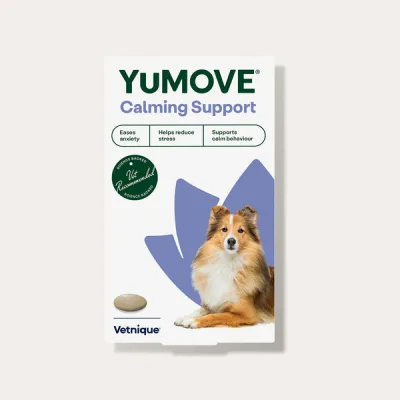
YuMOVE
Calming Support for Dogs
Once-a-day calming tablet: 200mg L-tryptophan with GABA fermentate, lemon balm and B-vitamins. Subscribe & Save at YuMOVE with free UK delivery.
£17.86first 2 Subscribe & Save orders, then £28.58; £35.72 one-off
Buy from YuMOVECaptain Calm earns a small commission from qualifying purchases through these links at no extra cost to you. Recommendations are based on independent research and review. Prices are pulled from each retailer and refreshed through the day; the price shown at checkout applies.
Keep reading
More on supplements & natural remedies

Melatonin for Dogs UK 2026: Dosing, Safety & Anxiety Relief
Can you give dogs melatonin in the UK? Only on a vet's prescription: melatonin is prescription-only here. The dose ranges vets use by weight, side effects, the xylitol risk, and the legal alternatives you can buy.

L-Tryptophan for Dogs UK: Dosage, Evidence & When It Actually Helps
L-tryptophan turns into serotonin and is in many UK calming supplements, but dog trials are mixed. Label doses by weight, what each study found, and which medicines it must not be mixed with.

Natural Sedatives for Dogs UK 2026: OTC Options & What Actually Works
No dog sedative is sold over the counter in the UK. Here is what you can buy instead: honest evidence ratings for valerian, L-theanine, Zylkene and more, which options need a vet (melatonin, CBD), and when to ask for prescription sedation.